What shipped
One Deposit. Three Invoices.
Three customers pay you in the same week. You walk the checks to the bank together. Your statement comes back showing one deposit.
Now reconcile it.
What most software does
Match the deposit against one invoice. Clean up the other two by hand — an adjusting entry, a note to yourself, maybe a credit you’ll have to explain later. Four minutes. Every month.
What BasicBMS does now
Split the reconciliation into as many allocations as the deposit actually contains — existing invoices, a brand-new invoice created on the spot, or a ledger code. Each one clears on its own line.
What changed
A reconciliation now splits. One deposit, as many allocations as it really holds.
Apply part of it to one customer’s open invoice. Apply another part to a different customer’s. And when a piece of that deposit is for work you never got around to invoicing — the extra cash for the panel rewire — create the invoice right there inside the reconciliation. You don’t leave the screen, go build it somewhere else, and come back to find your place.
Allocations can also land on a ledger code, so bank fees, interest, and tax go where they belong instead of into a catch-all you clean up later. The same thing works on money going out: split a payment across the bills it actually covers.
And it has to balance. You can’t file the transaction until the allocations add up to the deposit exactly — $0.00 remaining, or it doesn’t file. The books can’t drift, because the software won’t let them.
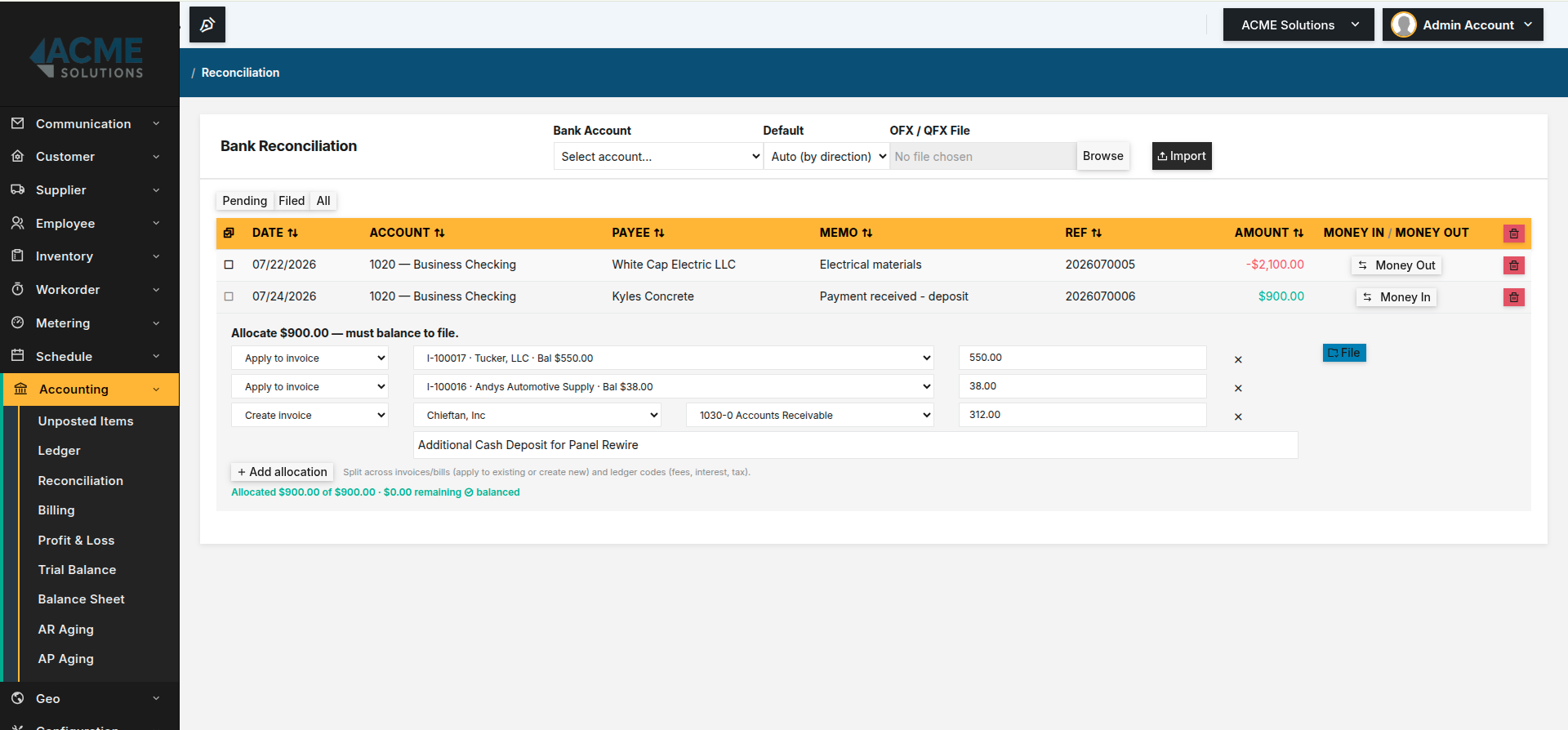
The bank record and your receivables finally describe the same event.
Why this is the part that matters
An adjusting entry is a small lie you tell your own books to make them balance.
It’s a defensible lie — every bookkeeper doing it knows exactly what it means, and it nets to zero. But it’s still a line in your ledger that doesn’t correspond to anything that happened in the world. Do it every month for a decade and your audit trail is partly a record of your accounting software’s limitations rather than your business.
Splitting the reconciliation removes the need to tell it.
Nobody asked for this
Not once, in any sales conversation, has somebody said their software should split a reconciliation across multiple receivables. People don’t ask because they’ve stopped seeing it — the four-minute workaround became part of what “doing the books” means.
That’s the category worth hunting. Not the thing customers complain about — the thing they’ve quietly built a habit around.
It’s the same reason the ledger posts itself: if you’ve actually closed a month, you know where the time goes.
Still modular
Start with what you run. Six core modules — Customers, Employees, Suppliers, Payables, Invoices, and a full general ledger — for $150 a month. Add Work Orders, Communication, or Projects for $25 each. Every user included, no per-seat games, no forced bundles.
Implementation is a one-time build: we configure your modules around your workflow and load your data, so you don’t start on a blank screen.

Business software as unique as your business.
 Water Utility→
 Property Management→
 General Business→
 Construction soon
Don’t see yours? Build a vertical →