Concept
What an ERU is and how it changes a bill
A restaurant on your system has six toilets, a commercial kitchen and a dish line. It draws the water of several houses through one meter, and your rate sheet says it pays like several houses: so much "per ERU". An ERU, an Equivalent Residential Unit, rates a connection as a number of ordinary houses. A house is 1, a duplex is 2, and a bigger user is whatever your district assigned it, usually from a fixture count. This article explains what the ERUs number on a service point does to a bill in BasicBMS, so you can check a multi-ERU bill by hand and explain it to the customer who calls.
Terms used here
- ERUs: a field on the service point, under Invoice Template:. Its hover text reads Equivalent Residential Units: how many ordinary houses' worth of water this connection is rated at. Multiplies the base charge. It is 1 unless you change it, and it steps in halves.
- Fixed charge and usage block: the two kinds of row on a Tiered rate. A fixed charge bills once per bill; a usage block charges the units between its Min and Max.
- Service point: the connection the bill belongs to, not the person who pays it.
How it works
The ERUs number does two things on every bill the point gets.
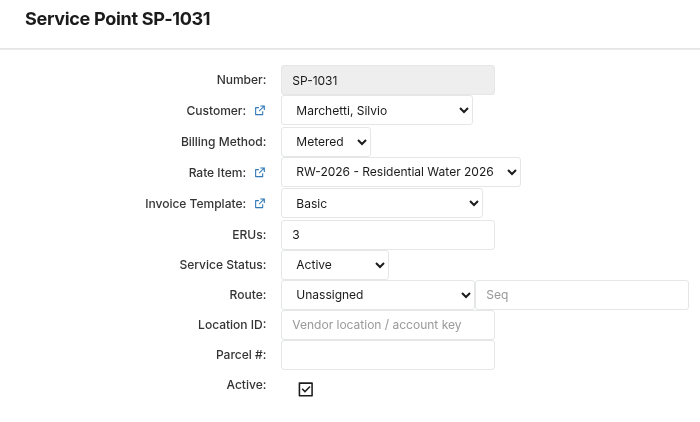
It multiplies the fixed charges. Every fixed charge on the point's rate is billed ERUs times. The line shows it, so nobody has to guess: on a point rated 3, a $101.35 base charge prints with the detail Water Service × 3 ERU and bills $304.05.
It widens the usage blocks. Each block's Min and Max are multiplied by the ERUs, and the price per 1,000 gallons stays the same. A 3-ERU connection gets three houses' worth of included water and three houses' worth of each tier before the next price starts. The meter reading itself is never multiplied. The point used what it used.
| Block on the rate | At 1 ERU | At 3 ERUs |
|---|---|---|
| Included, $0 | 0–7.5 kGal | 0–22.5 kGal |
| $4.55 per 1,000 | 7.5–15 kGal | 22.5–45 kGal |
| $7.45 per 1,000 | 15–45 kGal | 45–135 kGal |
| $10.65 per 1,000 | 45 kGal and up | 135 kGal and up |
A 60,000-gallon month at 3 ERUs:
| Line | Detail | Amount |
|---|---|---|
| Basic Monthly Service | Water Service × 3 ERU | 304.05 |
| Metered Usage (0–22.5 kGal) | 22.5 kGal @ $0.00/kGal | 0.00 |
| Metered Usage (22.5–45 kGal) | 22.5 kGal @ $4.55/kGal | 102.38 |
| Metered Usage (45–135 kGal) | 15 kGal @ $7.45/kGal | 111.75 |
| Total | 518.18 |
Why the blocks widen too. Three ordinary houses using 20,000 gallons each would pay $172.73 apiece, $518.19 together. The 3-ERU connection using the same 60,000 gallons pays $518.18; the cent is rounding. That is what "per ERU" means on a rate sheet. If only the base charge were multiplied, the same month would bill $721.43, because the connection would climb the tiers as though one house drank all of it.
Where you'll see it. The point's next bill on Billing → Dashboard counts its ERUs. The What would this bill? preview on the rate item does not, because it prices the item, not a point: it always shows 1 ERU. On a partial period, such as a final bill, ERUs and proration multiply together: a 2-ERU point billed for 46 of 92 days pays the base charge once. Add-on charges, such as septic, bill their own quantity and ignore the ERUs.
What posts behind it
ERUs post nothing on their own. The bill's lines post as usual. On the $518.18 bill, with the rate's rows pointed at separate revenue accounts:
| Account | Debit | Credit | |
|---|---|---|---|
| DR | Accounts Receivable | 518.18 | — |
| CR | The fixed charge row's GL account (base charges) | — | 304.05 |
| CR | The usage block rows' GL account (water usage) | — | 214.13 |
| Balanced | 518.18 | 518.18 |
Rows left on Item's account credit the default sales account instead, in one line.
When it won’t let you
ERUs must be more than 0 (1 for an ordinary house). The field was 0 or negative when you clicked Save. There's no such thing as a zero-ERU connection here. If the point shouldn't bill, that's a matter for its billing schedule, not its ERUs. A blank field saves as 1.
What this doesn't do
It doesn't work the number out for you. There's no fixture calculator; you enter the ERUs your district assigned. It applies to every fixed charge on the point's rate, so a charge your sheet bills once per connection, whatever its ERUs, belongs on the point as an add-on instead. And it has no history: change the number and the next bill uses the new one, with nothing on the point to say what it was before. Note the change and the date on the account.
Related
Stuck on this one? Call (509) 955-0770 and we'll walk through it with you.

Business software as unique as your business.
 Water Utility→
 Property Management→
 General Business→
 Construction soon
Don’t see yours? Build a vertical →