Case study
Moving a 1912 water company off Excel: the Pomona Artesian case study
The billing was accurate. That was never the problem. The problem was that all of it lived in one workbook, kept by one family, for over a hundred years.
Pomona Artesian Irrigation Company is a small water system outside Yakima, Washington. In 2026 it moved its billing and accounting off Excel and onto BasicBMS, water company billing software built for systems its size. Here's what that took, what it turned up, and what it didn't need.
I'm on both sides of this one
I live in Pomona's service area. I joined the board when the people running it were getting older and needed help, then served as trustee and president. When our operator retired, I took over operations, and in March 2026 I became a licensed water operator.
I also build BasicBMS. So read this as an operator's account of moving his own water system, not an independent review. Every number in it is Pomona's.
The system
Pomona draws from a single artesian well with a natural flow of several hundred gallons a minute. The family that drilled it in 1912 ran the company until recently. As the Washington State Department of Health and state water-resource rules tightened, Pomona put a meter on every service point and on the source.
Billing is a flat quarterly rate per service point. The books were paper, receipts, and an Excel workbook, and they were kept with real precision.
Why move a system that works
Small water companies don't usually fail because the spreadsheet is wrong. They get into trouble because the person who understands the spreadsheet leaves.
The people who run these systems often hold the job for 30 or 40 years. When the job changes hands, the knowledge goes with them, and the next board inherits a water system it can't run. Pomona had just been through exactly that handoff.
The goal wasn't better billing. It was billing the next person can pick up.
We called it portability: records that move cleanly from one water operator to the next, from one manager to the next, and between operations and whoever does the books.
The workbook
Accurate, but it lives on one computer and in one person's head. The rules for prepayments, discounts and late fees are habits, not settings.
Water company billing software
Every account, payment and fee in one record anyone with access can open. The rules are written down in the system, not remembered.
The migration, step by step
This is the part boards worry about, and it turned out to be the simple part.
- Accounts. Each customer in the billing workbook was written out to its own file, then loaded into BasicBMS.
- History. We imported the previous year of payments. That was enough. Nobody needed every payment back to 1912 to bill the next quarter correctly.
- Rates. Flat rate per service point, so there was nothing to translate. Every connection gets the same charge.
What the migration turned up
Putting every account in one system made a few things visible that the workbook had been absorbing quietly:
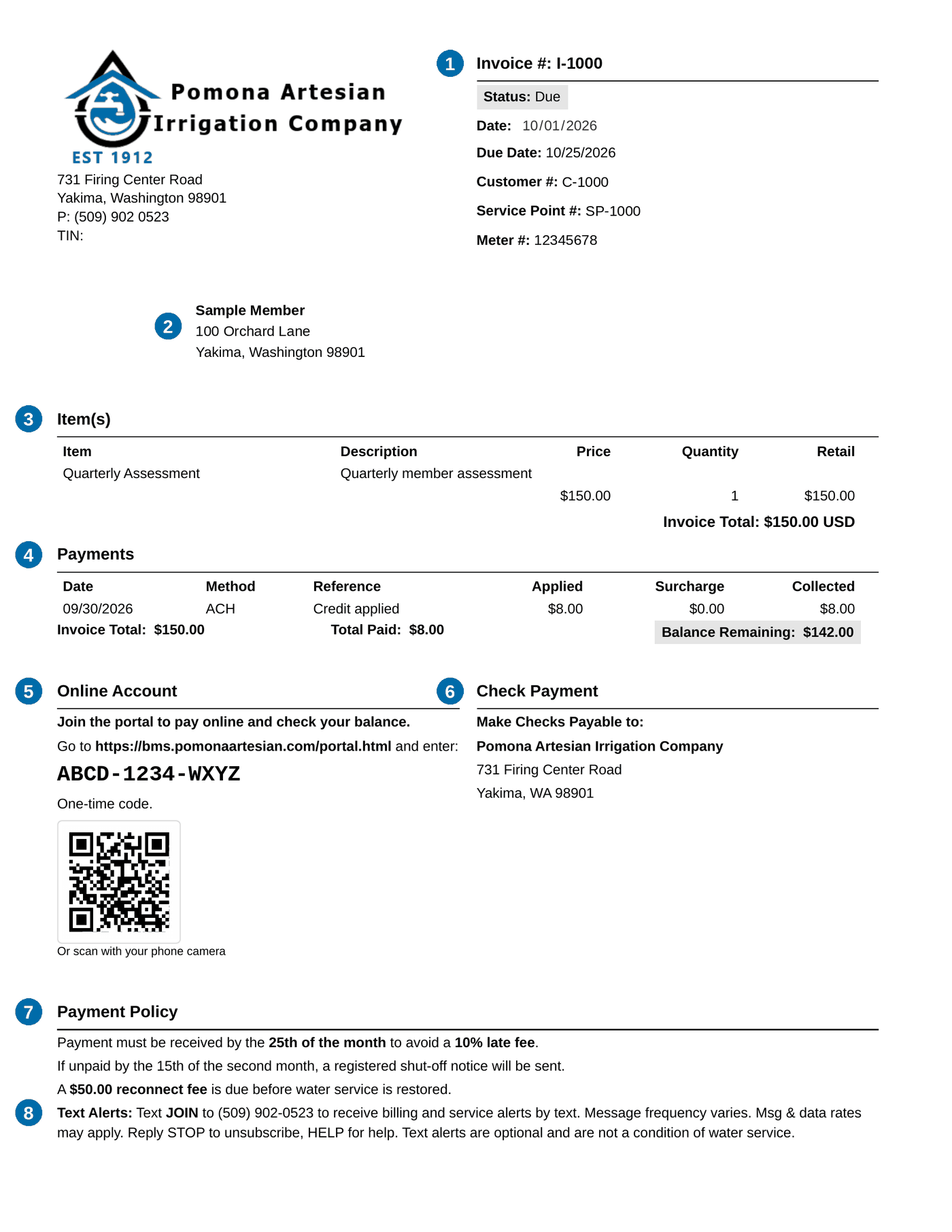
- Deferred revenue. Members who pay ahead had been easy to count as income the day the check arrived. It's really a credit owed against future quarters. See why a prepayment isn't a negative receivable.
- Discounts. Applied by rule now, the same way on every account they belong to.
- Late fees and returned-check fees. Tracked per account, so none gets charged twice or skipped. The setup is in How to set up late fees.
What Pomona has now
The software was the main reason for the move, but Pomona came out of it with more than billing:
- A website to post water quality reports and notices
- A social media presence for updates and outages
- Branded email at pomonaartesian.com, owned by the company rather than whoever holds the job
- One business phone number that routes to whoever is on duty
- Accounting and finance in the same system as billing
And one thing small systems rarely have. If Pomona's operator, manager or treasurer changes, BasicBMS is still there as a resource that already knows how Pomona's system is set up.
Starting from a spreadsheet is fine. Every account in it can be brought in. What you need to decide is how much payment history to bring, and for Pomona one year was enough.
What's next: meter data
Flat-rate billing made Pomona an easy system to bring over. The meters are already installed. The next phase is reading them reliably and using the data to find leaks and water loss early. That's the step from billing software to actually managing the water.
Pomona explained the move to its own members in Why Pomona Artesian moved its water billing out of the shoebox. The earlier post here covers what Pomona runs on BasicBMS day to day.
Pricing for a system this size
BasicBMS for water utilities is $3 per hookup per month, with a $100 monthly minimum. Every user is included. Implementation is a one-time build where we migrate your accounts and meters and set up your rates. The full breakdown is on what utility billing software costs, and the water features are on the small water utility billing software page.

Business software as unique as your business.
 Water Utility→
 Property Management→
 General Business→
 Construction soon
Don’t see yours? Build a vertical →